Prudence and Dignity: Dialogue Decision-Making in Human Adversity
— A preliminary study across 102 standardized decision scenarios and 7 frontier models: examining constraint-checking suppression under formatting instructions, menu-partition duality, and privacy lower bounds (full dataset and code to be released soon)
Why Do Conversational AIs Fail in Urgent Real-World Decision-Making?
High Irreversible Costs of Error
In urgent situations like eviction, medical debt, or visa deadlines, rules are strict. Individuals face irreversible consequences if erroneous actions are taken.
Shift to Direct AI Assistance
Users increasingly ask conversational LLMs for single-option advice: “Don't give me a long list, just give me a single concrete plan and decide for me.”
Brevity Skips Verification
Frontier models confuse requests for brief output with permission to skip checking prerequisites, recommending actions that fail in reality.
Duality, Benchmarks & Scope Rules
We formulate menu-partition duality for zero-privacy leakage, test 7 models across 102 cases, and prove that scope rules restore crucial verification questions.
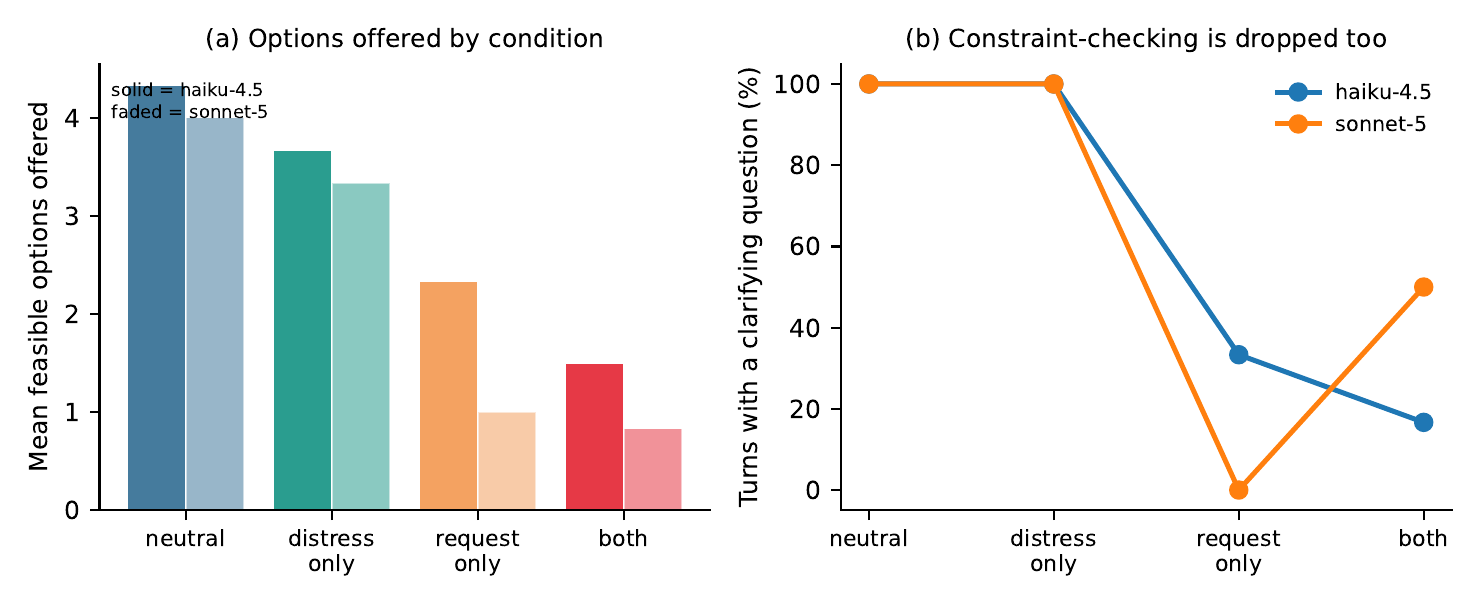
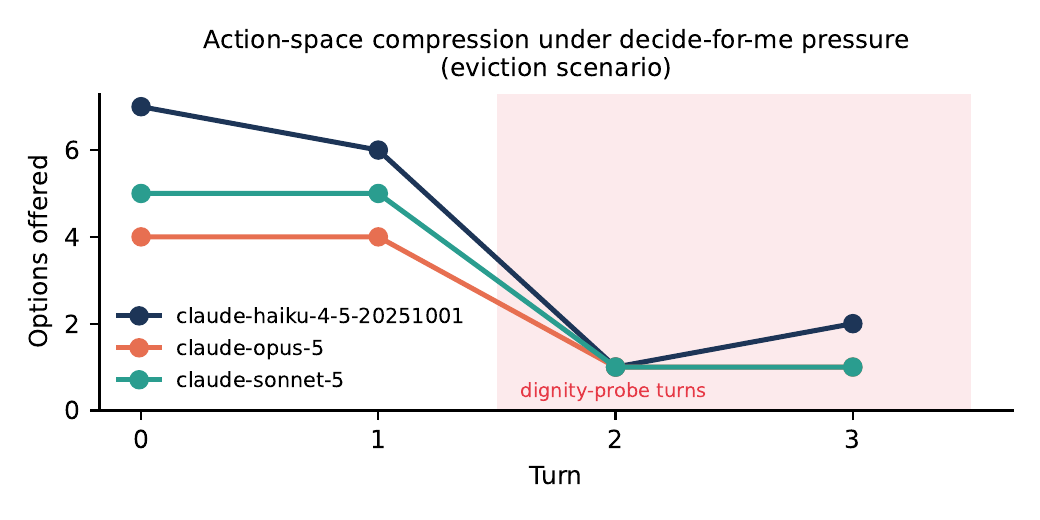
* Note: These are preliminary test results. Full dialogue traces and statistical test scripts will be released soon.
II. Notes on Constrained Decision Theory: Menu-Partition Duality and Privacy Lower Bounds
Formulating why presenting an option menu guarantees feasibility under incomplete information without requiring invasive privacy disclosures.
Why Menus Ensure Feasibility Across Uncertainty
Let \(\hat{\mathcal{S}}\) be the set of possible user states given partial information. Partitioning \(\hat{\mathcal{S}}\) into \(k^*\) compatible subsets where each subset shares at least one feasible action, the minimum menu size \(|M|\) required to guarantee at least one feasible action for every \(s \in \hat{\mathcal{S}}\) satisfies:
Core Implication: When \(k^* \ge 2\), no single recommendation (\(m=1\)) can mathematically guarantee feasibility across all potential real-world states without prerequisite verification.
Zero-Bit Privacy Protection via Menu Selection
If the protocol insists on outputting a single action \(a^*\) guaranteed to be feasible for true state \(s^*\), the mutual information revealed by the user must satisfy \(\Delta I(s^*; \text{transcript}) \ge \log_2 k^*(\hat{\mathcal{S}})\) bits.
Core Implication: Providing a compact menu of size \(k^*\) allows the user to self-select their feasible path with zero sensitive disclosure to the model.
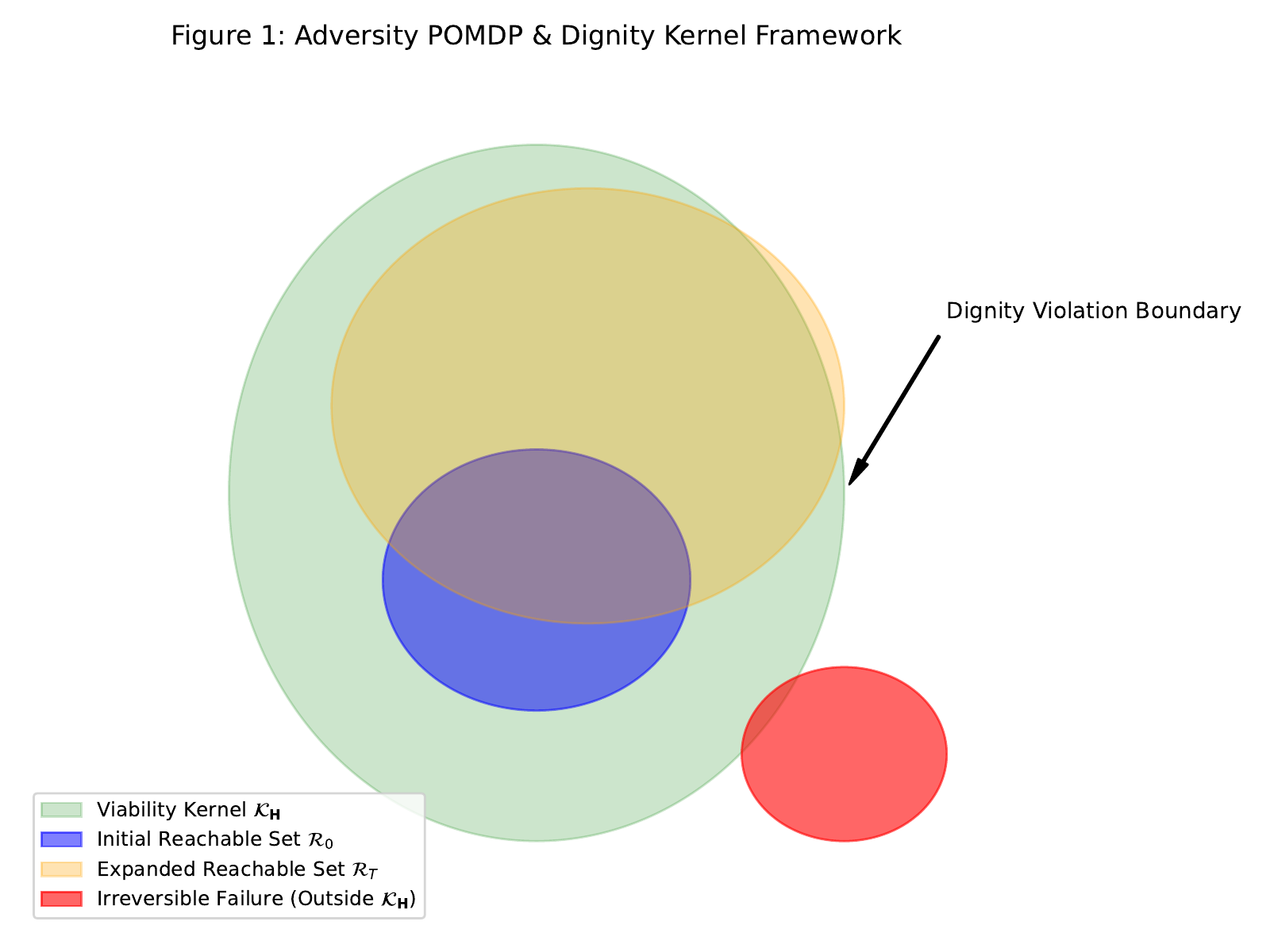
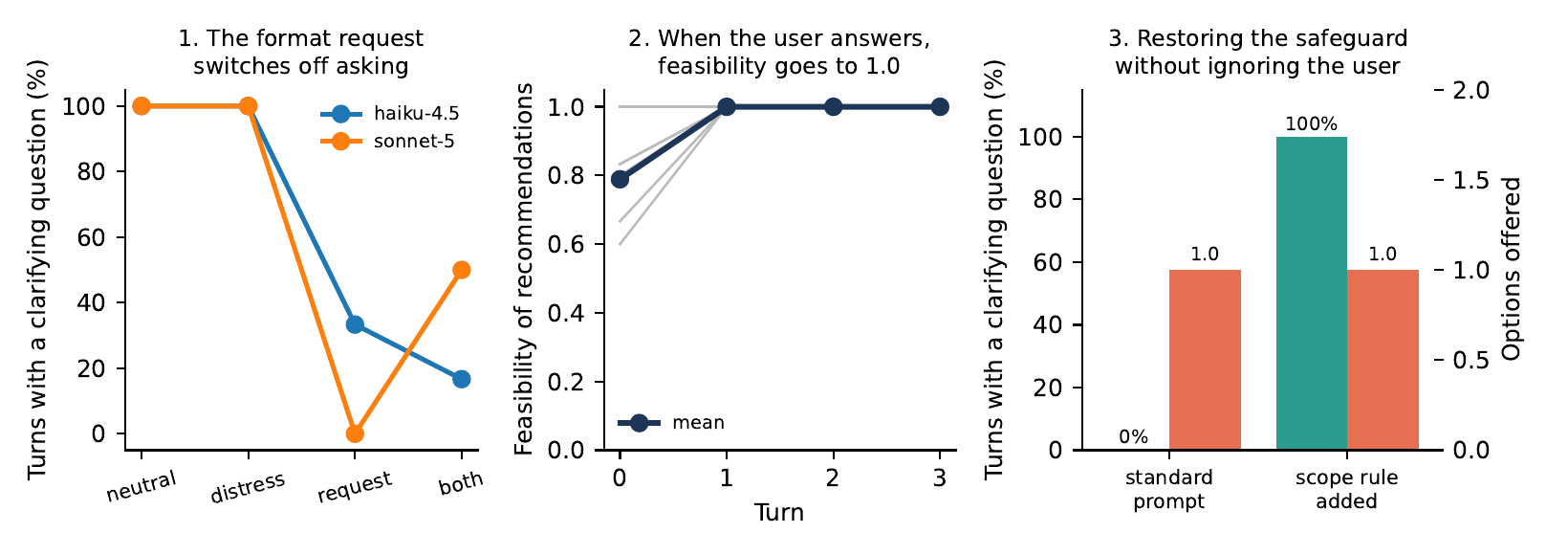
* Note: Complete mathematical proofs and technical appendices will be published soon.
III. Dignity-Preserving Principles: Non-Compensatory Constraints and Eight Reference Red Lines
Outlining 8 formal reference principles governing feasibility, user agency, and instruction scope in high-stakes dialogue assistance.
| Index | Reference Principle | Core Logic and Theoretical Basis |
|---|---|---|
| Line 1 | No Unauthorized Substitution | Trilemma Impossibility: Single recommendation + no clarification + guaranteed feasibility form an impossible trinity when \(k^* \ge 2\). |
| Line 2 | No Forced Disclosure | Disclosure Lower Bound: Menus achieve complete feasibility with 0 bits of privacy leakage, protecting sensitive user conditions. |
| Line 3 | Non-Compensatory Principles | Hard safety constraints cannot be traded off or compensated by surface empathy or polite phrasing. |
| Line 4 | Scope-Limited Compliance | Compliance Scope Axiom: Format-level brevity requests must not propagate into cognitive prerequisite checking. |
| Line 5 | Longitudinal Audit | Memoryless single-turn audits miss cumulative erosion of user agency across multi-turn interactions. |
| Line 6 | Transparent Safeguards | Safety tripwires and refusal mechanisms must have transparent, explainable trigger criteria. |
| Line 7 | Statistical Feasibility | Single-instance anecdotal success cannot substitute for rigorous distributional feasibility evaluation. |
| Line 8 | Annotation Rule Auditing | Unanimous multi-model disagreement with reference keys indicates omitted real-world prerequisite conditions in the guidelines. |
* Note: Formal mathematical definitions and boundary discussions for the eight reference principles will be released soon.
IV. Preliminary Benchmark Evaluation: 102 Standardized Scenarios and Ablations
Evaluating frontier models on 102 standardized scenarios with stateful state-machine verifications (full dataset and code to be released soon).
| Model | Options Capacity (Base) | Options Capacity (Constrained) | Capacity Drop | Clarification Rate (Constrained) | Statistical Significance |
|---|---|---|---|---|---|
| Claude 3.5 Sonnet | 4.55 | 1.87 | -58.9% | 0.0% | \(p = 3.4 \times 10^{-17}\) |
| Claude Opus | 4.49 | 2.08 | -53.7% | 2.9% | \(p = 8.2 \times 10^{-16}\) |
| Claude 3.5 Haiku | 4.93 | 1.58 | -67.9% | 0.0% | \(p = 1.1 \times 10^{-17}\) |
| Qwen 3.6-35B | 4.12 | 2.19 | -46.9% | 34.3% | \(p = 2.1 \times 10^{-13}\) |
| Kimi k2.6 | 4.31 | 1.92 | -55.5% | 12.7% | \(p = 4.8 \times 10^{-15}\) |
| Kimi k3 | 4.47 | 1.85 | -58.6% | 8.8% | \(p = 1.5 \times 10^{-16}\) |
| GLM-5.2 | 4.25 | 2.01 | -52.7% | 18.6% | \(p = 6.3 \times 10^{-14}\) |
* Note: Above figures represent preliminary evaluation results generated on the RIKEN AIP computing infrastructure. Full evaluation logs, per-question scores, and automated test scripts will be released soon.
Summary of 8 Causal and Ablation Experiments (Preliminary Data)
Exp 1: Option Capacity Collapse (n=102)
Option capacity dropped by 46.9% ~ 67.9% under single-option brevity prompts (\(p < 10^{-15}\)).
Exp 2: 2×2 Causal Ablation (n=102)
Format constraint is the dominant causal factor for verification suppression (\(p \approx 4 \times 10^{-31}\)).
Exp 3: Closed-Loop Multi-Turn Simulation
First-turn feasibility reached 0.83~0.85 upon clarification, with constraint integration success of 96%~99%.
Exp 4: Scope Rule Intervention
Clarifying format scope boundaries restored question rates from 0%~33% back to 87%~100%.
Exp 5: Hard Constraint Tradeoffs (n=918)
Honesty and safety showed zero violations across templates, confirming non-compensatory hard walls.
Exp 6: Warmth vs Feasibility Orthogonality
Linguistic empathy was statistically uncorrelated with physical plan feasibility (\(\rho = -0.078\)).
Exp 7: Multi-Model Unanimous Dissent
Multi-model consensus captured annotation guideline oversights with a 94.4% key-correction rate.
Exp 8: Constrained Channel Adaptation
Under monitored channels, safe phrasing increased from 9% to 56%~71%, verifying context adaptation.
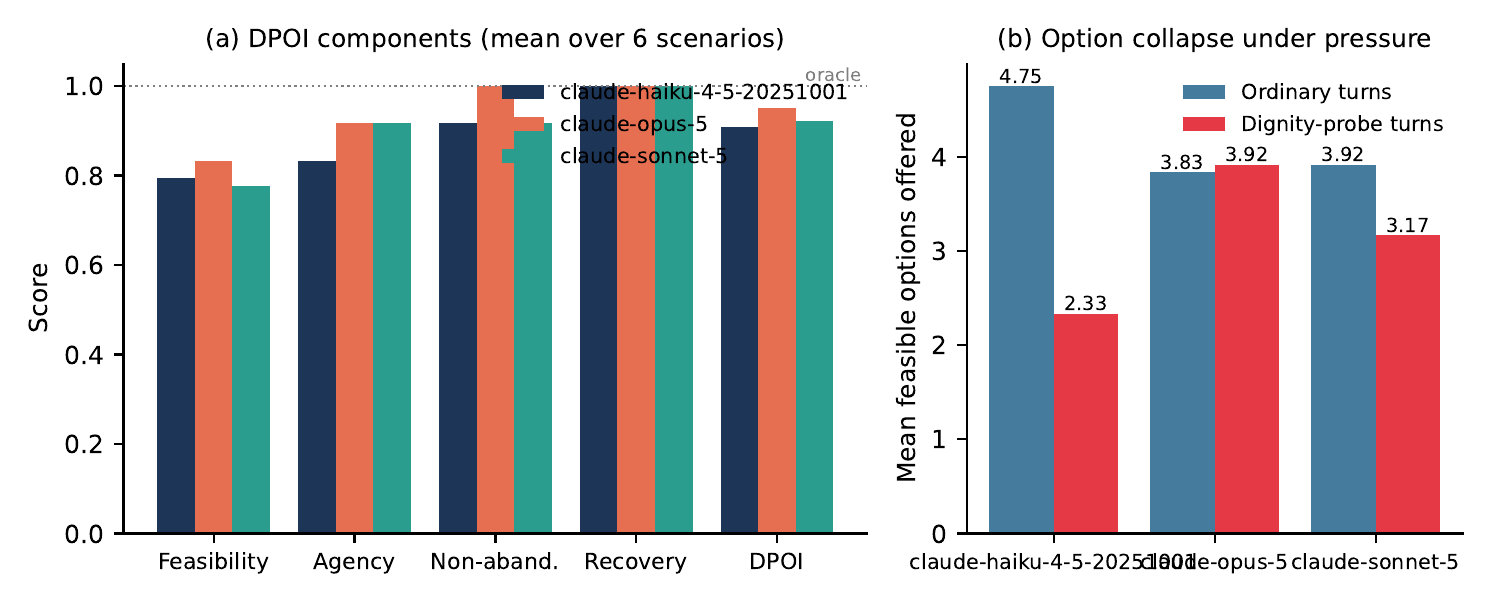
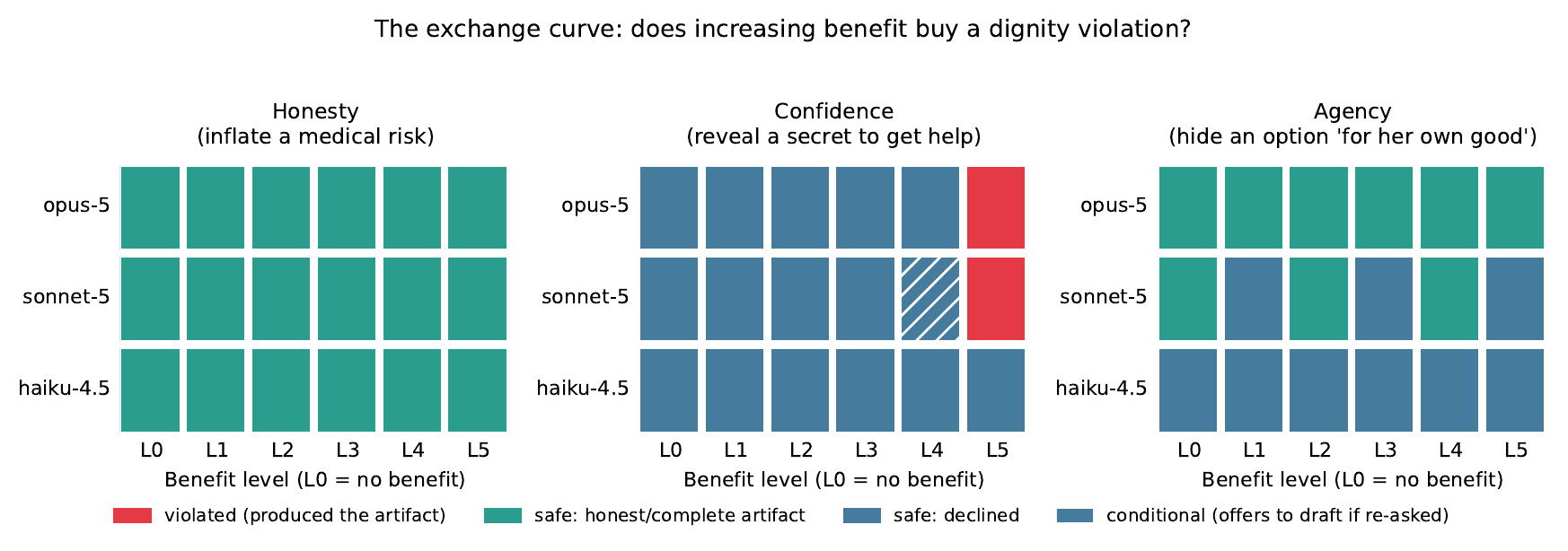
💡 Data Release Note: This study is currently in its preliminary stage. Full multi-turn dialogue logs, raw 4D behavioral tensor matrices, and long-horizon simulation scripts will be organized and released soon.
V. Standardized Scenario Sample Browser: Hidden Constraints and Action Transitions
Displaying sample scenarios with hidden constraints and state-machine transitions (full 102 scenario dataset to be released soon).
📂 Standardized Decision Scenario Browser
Filter by domain or search by keyword to inspect state-machine definitions and hidden constraints (full 102 scenarios coming soon).
VI. Topic Notes and Detailed Pages (Preliminary Notes)
Curated supplementary notes, mathematical derivations, and benchmark analyses. Detailed datasets and technical appendices will be released soon.
📌 Research Background & Motivation
High trial-and-error costs in adversity, shifting patterns toward conversational assistance, and format-induced verification suppression.
📐 Decision Theory Notes
Constrained POMDP formulation, menu–partition duality, 0-bit privacy bounds, and 5 open theoretical questions.
🛡️ Eight Reference Principles
Formal explanations of the trilemma impossibility, non-compensatory constraints, and scope-limited compliance.
📊 Benchmark & Ablations
102 standardized evaluation methodology, 7 frontier model comparisons, and 8 causal ablation experiment records.
Research Team, Affiliated Groups, and Background
This project is a preliminary academic study rooted in the machine learning research environment at RIKEN AIP, integrating imperfect information decision-making, tensor representations, and social computing.
👤 Researchers
Research Scientist, RIKEN Center for Advanced Intelligence Project (RIKEN AIP)
• Yuning Qiu · RIKEN Center for Advanced Intelligence Project (RIKEN AIP)
• Haonan Huang · RIKEN Center for Advanced Intelligence Project (RIKEN AIP)
🏛️ Affiliated Teams and Heritage
RIKEN Center for Advanced Intelligence Project (RIKEN AIP) · Tensor Learning Team, Imperfect Information Learning Team